
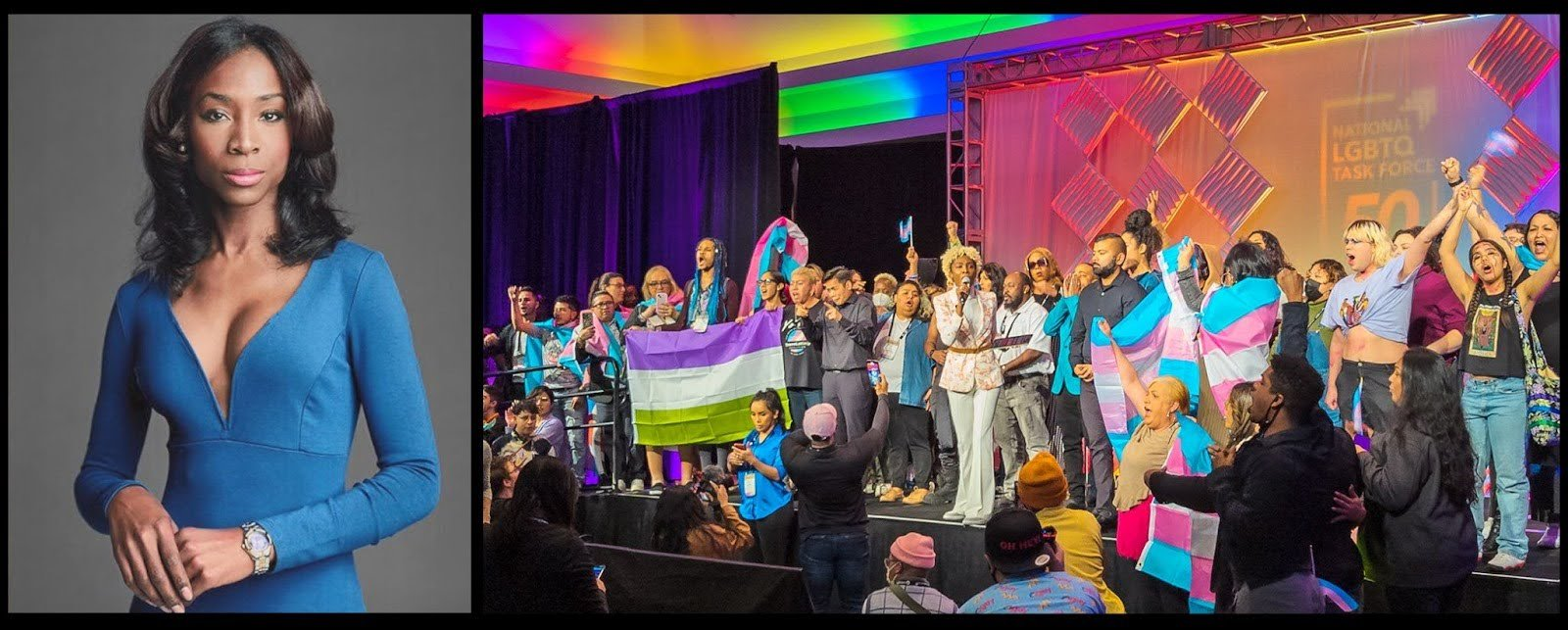
Angelica Ross is a woman of many talents. She is well-known for her acting in roles such as Candy Ferocity on the groundbreaking FX series Pose, multiple characters in the anthology series American Horror Story, and Roxie Hart in the musical Chicago, making history as the first openly trans woman to headline a Broadway show. Beyond the stage and screen, Ross is also the founder and executive director of the trans-centered technology community TransTech Social Enterprises, and an outspoken activist for transgender and racial equality and human rights.
This year, Ross extended her talents to the political sphere, becoming communications director for Butch Ware, Green Party candidate for governor of California. Assigned Media reached out to Ross for her thoughts on this new position, as well as other issues affecting Black and trans folks in the US. (The interview has been lightly edited for length and clarity.)
Assigned Media: How did you come to be involved with the Butch Ware gubernatorial campaign?
Angelica Ross: When I first encountered Dr. Ware’s work, what struck me wasn’t just his politics — it was his consciousness. Here is a scholar, an activist, a Muslim man who has dedicated his life to understanding how power operates and how communities are liberated from it. That spoke to something deep in me.
Watching him on the presidential trail as Jill Stein’s running mate on the Green Party ticket gave me a glimpse of what was possible— a sign that real change was on the horizon. Then came the media moment that broke trust with the trans community, when Dr. Ware repeated the framing of an interviewer who asked whether he approved of “biological males” in women’s sports. But I watched his face, I watched his heart in that moment, and I knew this was a misunderstanding — not a conviction. So I reached out to him directly.
What followed was a real dialogue. I helped him understand why our community was rightfully upset, what implications that language carries, how that framing comes from a place of fascist ideology, and how systemic transphobia — even at the Olympic level — ultimately harms cisgender women as well. He listened. He engaged. And since then, Dr. Ware and I have developed an ongoing friendship.
I came on as Director of Communications because I believe California deserves a governor who isn’t just managing the status quo — it needs a leader willing to reimagine what’s possible.We are in a moment where the two-party system has demonstrably failed the most vulnerable people in this country. I’m not interested in playing it safe anymore. None of us can afford to.
AM: What are your thoughts on Gavin Newsom, both as governor of California and a potential presidential candidate?
AR: I’ll say this — Gavin Newsom is a skilled politician, and I don’t use that as a compliment or a criticism, just a description. He knows how to read a room and position himself. I share that same skill. I just choose to use my powers for good.
When I look at California’s unhoused population, our wealth inequality, and what trans Californians are still navigating — I have to ask: is this really about the people, or is it about political aspirations? Ambition without accountability is just a performance. If he runs for president, voters deserve a very honest conversation about the gap between his brand and his record.
AM: In an interview with OUT magazine in 2024, you said that you yourself were preparing to run for political office in Georgia. Is that still in the cards? What advice would you give to other trans office-seekers in today’s political climate?
AR: I’ve always understood that even though I bring strong leadership skills to any collaboration, I’m also willing to follow someone who is ready and able to lead in a given moment. I believe Dr. Butch Ware has been forged through fire by the last presidential campaign and that kind of seasoning matters. Right now, my place is beside him.
Georgia is still in my heart. I have deep roots there and deep love for the people there, especially Black trans women and femmes in the South who are doing extraordinary work with very little protection and even less recognition. Whether the timing is right for a run, and where, is something I continue to sit with in my practice.
What I will say is this: the question for any trans person considering public office right now can’t just be “Can I win?” It has to be “Am I prepared for what visibility at that level will cost and do I have the community around me to sustain me?” Do the inner work first. Know your why so deeply that no opposition research, no transphobic attack ad, no moment of doubt can shake it. Build your circle before you announce. And don’t wait for the Democratic Party to validate you — they will follow your momentum if you build it yourself.
AM: Since you retook the reins of TransTech in 2024, the Trump administration has been aggressively targeting trans people and DEI initiatives. How have these actions affected your plans for the organization?
AR: It has honestly clarified them. When the external environment becomes hostile, you stop relying on institutions that were never fully committed to you anyway, and you build your own. That’s always been the TransTech ethos. We are not asking for a seat at the table, we are building tables.
What the current administration has done is remind our community and our allies that we cannot outsource our survival to people in power who may rescind their support the moment it becomes politically inconvenient. TransTech is creating what I call our own human VPN — a protected, connected ecosystem where our people can thrive regardless of what’s happening in Washington. The attacks haven’t stopped us. If anything, they’ve made the mission more urgent and the community more hungry for what we’re building.
AM: March 31 is the Trans Day of Visibility. What are your thoughts on the risks and rewards of being visible as an openly trans person in the U.S. today, particularly for Black trans women like yourself?
AR: Visibility has always been a double-edged gift for us. Being seen can mean being celebrated — and it can mean being targeted. For Black trans women specifically, visibility has historically included violence. That is not hyperbole. That is our lived reality. I never tell a trans person, especially a young Black trans woman, that they must be visible. That is a choice that belongs entirely to them, and it comes with real risks. My own visibility has been one of the most powerful tools I’ve ever embraced. Not because it made me safe — it didn’t, not always — but because it made the impossible seem possible for others. Every time someone saw me on screen, on a stage, in a news story, and thought “I didn’t know we could do that,” mattered. That still matters.
My Buddhist practice teaches me that our lives are the message. So on Trans Day of Visibility, I’m not asking people to perform bravery they don’t feel. I’m asking the world to be worthy of the courage our community has already shown. And I’m encouraging us to focus on how we see and value ourselves and each other — because I am less and less concerned with how I’m perceived by people I’m not in community with.
AM: What advice would you give to cis allies on how best to help the trans community at this time?
AR: Stop waiting to be told exactly what to do and start being uncomfortable on purpose. Allyship that only activates when it’s easy or popular isn’t allyship, it’s optics. Show up in the rooms where trans people aren’t present and say something. Challenge your own institutions. If your company quietly scrubbed its DEI language to avoid federal scrutiny, say something. If your church, your school board, or your neighborhood association is silent on anti-trans legislation, say something. Invest directly in trans-led organizations. Not just the big, well-branded ones, but the grassroots ones, the Black trans-led ones, the ones operating where visibility is most dangerous and resources are most scarce. Money is allyship. Time is allyship. Using your privilege as a shield so someone else doesn’t have to take every blow—that is allyship.
We don’t need your sympathy. We need your solidarity.
Pax Ahimsa Gethen (they/them) is a queer Black trans writer and editor. They live in San Francisco with their spouse Ziggy.





Such a good read! Very good interview, and such a beautiful, smart woman.