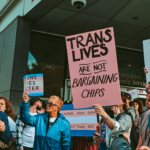
Susan Stryker is a trans historian and theorist whose historical research, theoretical writings, media-making, activism, and academic field-building activities have helped shape the conversation on trans issues since the early 1990s. She spoke with Riki Wilchins of Assigned Media about the way her work informs the moment of rising fascism and civil rights backsliding we find ourselves in today.
Assigned Media: Congratulations on the publication of your third edition of Transgender History. I notice the subtitle has changed from “The Roots of Today’s Revolution” to “A Resource for Today’s Struggle—and Tomorrow’s.”
I thought trans history ended in 2016 when the Attorney General went on national TV and said, “We see you,” and even NASCAR supported a boycott of North Carolina over a single routine bathroom ban. But it turns out trans history is still being written. How did you deal with that in this edition?
Susan Stryker: That was one of the great challenges. Not only for this book, but for another one coming out in August called Changing Gender, which is the intellectual history. For both one of the great challenges was grappling with how much the story has changed. When the first edition came out in 2008, where what I think of as the sort of the queer movement that came out of the AIDS crisis, the collapse of the Soviet Union, globalization, and the internet, the arc from the early 90s moment was still on the upward swing. We were trudging towards some kind of political success, winning hearts and minds, changing the atmosphere around trans issues. And it seemed very hopeful.
By 2016, when that second edition came out, in the aftermath of the first Trump election, it was like, this is a setback, but onward. It wasn’t clear how much of a fluke Trump was and just exactly how hard the fascists were going to go. But it’s become clear in the eight years or nine years since that we’re in a different story now.
AM: I wrote an unfortunately triumphalist book in 2016 basically saying that we took on gay rights, feminism, and the media and won. It was true, but it was also wrong. What the book didn’t say and what I did not see coming was that we had never taken on the most powerful force in American politics today—the Christian Right. They pivoted to attacking trans people, who had been fighting battles for inclusion in gay rights and against TERFs but had no experience on that much bigger playing field.
SS: Yeah, I think there’s something to that. I think the T has always been an awkward fit with LGB because it runs on a different axis, so to speak. It’s not a sexual orientation, but it’s about embodied identity. You know the cliché: it’s not who do you want to fuck, but who you want to fuck as. But this whole division between sexual orientation and gender identity is of relatively modern derivation. If you look back before World War II, there’s still this idea that everybody’s got a little bit of male and a little bit of female in them and it’s a spectrum with intermediate cases. And if you go back even further, there’s the older sexological model of thinking about homosexuality as a kind of gender inversion.
So there are ways that the gay and the trans have always been tangled up with each other. And I would say questions about intersex as well, because so many of the theories from earlier decades is that if there’s a biological cause of homosexuality or transness, it’s kind of like an intersex/DSD condition. So it’s always been a messily-entangled set of identities or ways of thinking about these overlapping identities.
But back to the issue about what’s changed, I would have thought in 2014 or 2015 that the tide of history was clearly on our side.
AM: I still think it is, actually. I think this is the last big fight.
SS: I just think it’s longer. The phrase that keeps coming to my mind, which is from Joe Biden’s infrastructure bill, is “Build Back Better.” I feel like that’s what we need to do.
In the trans movement we need to be very sober in our assessments of what worked and what didn’t. I agree with you that as long as we were thinking about a kind of a politics of inclusion within a liberal democratic capitalist state, it was a reasonable strategy. But what we did not plan for was the fascist success of the last few years. The whole framework has shifted and it’s different. We’re playing on a different field. Like what happened to most of center left and radical society: we weren’t really ready for what happened.
AM: It’s not just different, but it’s a new way of governing we’ve never seen before. Trump has purposefully gone maximalist on every front to overload the normal channels of response in Congress, the courts, and the media. Also, having spent thirty years battling radical lesbian-feminist TERFs, who were once to the left of Che Guevara, I’ve been shocked to see them now making common cause with rabidly anti-gay, anti-woman, anti-trans Christian Right.
SS: The difference really is between feminists who want to use power to advance their interest as a biologically-defined minority versus those wanting to build a politics among all those negatively affected by patriarchy. I think what got called radical feminism or TERF has always been predicated on biological determinism and in ways it’s kind of supremacist. I used to say that the more feminism is about civil rights for people with uteruses, the more it becomes akin to any other kind of biologistic ideology, including racism. And the more it’s critiquing systems of power with a vision of justice that is against structures of oppression, the less identitarian it is and more like a social movement than advocacy for a special biological category of people.
AM: There’s a great article by C. Libby, which documents how much the Christian Right has adopted the rhetorical frame of victim politics which TERFs have now been honing for decades. All the arguments about us being immoral or perverts are all mostly gone. Instead, they’re posturing as the big protectors of women whose reproductive rights they can’t wait to take away
I’ve also been stunned by how the Christian Right has funded and led the creation of the anti-trans disinformation complex. In just the past decade, they’ve built an entire universe of “alternative facts,” pseudoscience they can point to that “proves” affirming care doesn’t work. Just like the Right “prove” that vaccines are bad and climate science isn’t real. So medications we’ve been giving since the 80s may now supposedly cause cancer and brain damage. But somehow only when they’re given to trans kids. It turns out that hormones and blockers are an incredible new intelligent class of drugs that can tell the gender identity of the body ingesting them.
SS: We live in an evidence-based society, but we can’t agree on what evidence is anymore. We can’t agree on what’s empirical. We can’t agree on a cosmology. So what’s happening with trans issues now, it isn’t like we can say, Let’s look at the evidence and make a rational decision. We can’t agree on what the framework for looking is. So we’re in the middle of a war. You know, it’s just a war.
AM: I’m going to gently disagree in that I don’t think both sides are trying to look at the evidence. On the contrary, I think it’s an unfair fight because the other side is trying to bury the evidence. When I read the Cass Review, these were not people who were looking to do science, but to avoid the science. They knew all the answers going in. So we’re answering to evidence and rationality as you point out, but they can just make shit up and then we have to debunk it. So to me, these are not two competing worldviews. They are two completely different projects.
SS: I think maybe we’re talking past each other because I agree with you. With the Review, what’s key is the evidence they excluded—their lit review excluded 97% of the studies because it fell below their standards. So the NHS decided to stop providing care to minors. Just like that.
AM: And then lowered their standards for “exploratory” therapy, which they wanted to recommend. So they just moved the goalposts back and forth, which is something else we don’t get to do.
SS: Right. So I do think there’s two things going on. These are bad faith actors asking, How can we manipulate this to get the answer that we want? I do think that that happens. But I also think at another level that they do have a worldview and trans people are a problem for it. As that which cannot be.
There’s an epistemological problem buried in there that people are trying to resolve through an exercise of power. If you can’t win the debate, eliminate the other position.
AM: You were among the first scholars to call more attention to early Black and Latinx trans activists, such as the Compton’s Cafeteria Riot, and women like Sylvia Rivera and Marsha P. Johnson. But now it feels like we’ve kind of come full circle in some way. I think it was Paisley Currah who pointed to this kind of shallow hagiography being performed around them in which they’re now finally recognized as mothers of the movement, but at the cost of erasing the real material things they struggled with, like homelessness, survival sex, and police oppression. I think Dean Spade and Vi Namaste have also made that argument.
SS: I do think it’s true that anytime you set up heroes or founders of some kind, it flattens a complicated history. I mean, look at Harvey Milk or George Washington. I totally agree that we install these simple representations of complicated people and events. Stonewall was important but it gets mythologized as the beginning of something yet there’s little attention to the Compton’s Cafeteria Riot that preceded it.
AM: I think you were also among the earlier academics to consistently point out all the trans resistance that preceded Stonewall. It wasn’t like the earth was a fiery ball, then the crust cooled, life arose, and then there was Stonewall.
SS: Yeah, yeah. So, so but you know, like I always try to bring in a quote unquote intersectional perspective or to, like, not center the white story or yeah and I feel like I’ve learned to do that better and better over the, over the decades. Um.
AM: You’re also known for valorizing and recuperating the concept of trans monstrosity in now-famous pieces like “My Words to Victor Frankenstein Above the Village of Chamounix: Performing Transgender Rage.” I wonder how you feel that that concept has aged. I know you took some heat for it in the early years and not everyone was really happy with that. But it seems to have kind of weathered the storms and is much more widely accepted academically now.
SS: I’m still 100% in the tank for monstrosity. You know, I don’t think monstrosity is a bad thing. I get people not wanting to feel that they’re being made less-than by being rendered like a monster. That hurts. But trans people are never going to win the normie game, you know? We’re different. So why would I measure my own success as a person based on a set of criteria that are designed for me to lose. As I said 30 years ago, I find no shame in being put on the same plane of existence with not the non-human or the more-than-human.
SS: This is not a way of creating hierarchy and throwing most people under the bus. It’s recognizing that whole discourse as a game that trans people can’t win at. I feel like the rare rabbit in the briar patch. So when you want to throw us in the briar patch, that’s where I’m from, you know?
AM: I agree that cis standards of the normal or the human or gender is a game we can’t win at, because it was not only designed in our absence, but requires our absence for its legibility. But I also want to push back on this gently a bit, because we both know trans young people who are going through normal cis-style puberties And while every single thing you just said was certainly true for me, I don’t know if it’s going to be true in the same way for this generation.
SS: I think it’s a false hope that we’re ever going to be the same as. At least until we get to a place where there is no societal judgment based on being cis or trans. Until then, we’re still going to be put in a less than position.
I have great sympathy for early transitioning people since I knew I was trans from early age and yet was unable to transition until my 20s. It’s like, wow—what would life have been like, had I just sort of been able to be like who I am.
AM: I ask myself that all the time.
SS: But it’s kind of like passing. You can always be found out. There’s always going to be like a sense of difference. My authentic life is not a cis normative life. My authentic life is that I’m a trans person. There’s this thing about me, I have this life experience, and I’m going to live that and express that to the best of my ability.
AM: Jules Gill-Peterson has been writing this fascinating series on Substack about the early anti-trans laws, which she anchors in Saint Louis’s 1843 ordinance against cross-dressing. This was the first time any U.S. jurisdiction had shifted one’s gender from a personal matter between the individual and their family and maybe their pastor and made it into a state legal concern. Historically, she identifies this as the beginning of 200 years of state violence against trans femininity and anti-trans transmisogyny. Does that resonate with your view?
SS: Yes. There were earlier instances of states sanctioned anti-trans legislation and colonial New England. There were sumptuary laws that regulated dress. There was a person arrested for going about in women’s clothing in the night and breaking into houses in Puritan Massachusetts. In the aftermath of the Salem witchcraft trials, around 1695 there was a biblically-inspired law. But cross-gender behavior was not a matter of huge state concern. Mostly earlier laws were connected with public nuisance regulation of things like getting drunk or naked or swearing in public.
St Louis 1843 is the currently earliest known municipal ordinance specifically devoted to cross-gender presentation. If you look at Saint Louis, it was the jumping-off place for overland migration to the west. These are municipal laws that emerge in rapidly urbanizing places. San Francisco became a gold rush town, and went from a hamlet of 200 people to the largest city in the Pacific Rim in a decade. Columbus Ohio was the terminal point for the first national highway, the U.S.’s first high-speed ground thoroughfare. And so on. In every place where one of these ordinances is passed, political elites are trying to exercise a new form of social control over a very transient population of new unknown people on the streets. Cross-dressing regulation was a new instrument of power to regulate large, heterogeneous urban masses of people that no longer have any real social ties between one another.
AM: There are things happening on so many fronts right now. I worry that each of them is being seen as a disaster and we don’t always have enough time or bandwidth to analyze them in depth.
SS: It’s not a one size fits all authoritarian crackdown. It happens incrementally and piecemeal and unevenly. The fascist strategy against trans right now is also administrative. It’s not rounding people up and putting them against the wall, but just ratcheting down the possibilities for being trans in a complex nation state. Dean Spade writes about how so much of anti-trans violence is administrative and bureaucratic. I don’t shy away from the genocide word because this is a deliberate intention to destroy a category of people. It’s more what they call a paper genocide.
AM: In disability studies, they call that eugenics policy-making—remove the legal and civil recognition and rights needed for a disfavored group to survive.
Susan’s book is called Transgender History, third edition. It’s a resource for today’s struggle, and tomorrow’s. You can read it while waiting for her book Changing Gender this August. Thank you for joining Assigned Media today.
SS: Thank you for having me.
Riki Wilchins writes on trans theory and politics at: www.medium.com\@rikiwilchins. Her two last books are: BAD INK: How the NYTimes SOLD OUT Transgender Teens, and Healing the Broken Places: Transgender People Speak Out About Addiction & Recovery. She can be reached at TransTeensMatter@gmail.com.