

Before TikTok, Tumblr or LiveJournal, before widespread computer ownership or the web itself, trans people were connecting online, allowing them to talk to people like themselves.
For many, this was the first time. The earliest forums offered an invaluable space for people whose innate sense of being trans clashed with the prevailing culture. But there, in cyberspace, they built community and friendships.
The moderators of these trans forums, many of them volunteers, have demonstrated remarkable resilience and resourcefulness over four decades and multiple digital eras, often leaving themselves emotionally vulnerable and susceptible to burnout.
It was motivated, as one said, by love and the pursuit of knowledge.
The earliest forums were rudimentary, requiring the user to manually establish a connection, far from today’s immediacy of picking up a phone and posting. Once connected, information came in at a trickle. Sharing a selfie, trans-themed art, or a photo of updated ID, if it were even possible, was an elaborate process of scanning images, crushing them into tiny but hopefully recognizable proportions, and repeating steps when your connection failed or your computer crashed.
Yet the conversations then had a feel that is quite familiar today: celebrations of milestones, declarations of identity and denunciations of transphobia.
For the people running them, there was a lot of labor and out-of-pocket expense. “I’m racking up $200 in $300 bills each month being on the service to host chats,” Gwendolyn Anne Smith recalled of her time as a volunteer America Online moderator.
A through line during this period, and a source of some tension, has been the evolution of descriptive definitions. The rise of the internet coincided with the emergence of terms like non-binary and transgender as well as the expansion of the acronym LGB to LGBTQ+.
“These battles about that kind of – who belongs and how do we define this – have always been happening,” said Avery Griff-Dame, whose 2023 book “The Two Revolutions,” recounts trans people’s intertwined history with the digital world. “It’s just on contemporary platforms they’re much more focused on specific language. Using language to help define an in and an out.”
Our communities, especially early on, were also shaped by who had access to a computer. While robust statistics on internet users are hard to come by, especially users of specific online communities, the people who had the resources to use digital forums early on were “very white and very middle class,” Griff-Dame said.
Census data published in 1989 indicated that families making more than $75,000 were roughly nine times as likely to have a computer at home as those making less than $15,000; white families were twice as likely to have them as Black families. Media outlets took note of the trend, and politicians embraced the term “digital divide.”
As technology improved, barriers came down but didn’t disappear.
Jamie Fenton, a former system administrator for the enduring online space TG Forum, noted that scanners became cheap enough in the 1990s that many users could upload photos. The digital divide shrank in subsequent surveys, although Black, Hispanic, and low-income families remained slightly less likely to have a computer or internet connection at home.
As Barriers Fell
It was during this time that America Online emerged as a leading proprietary service, enabling users to form chat rooms on the fly under the banner People Connection and providing a burgeoning array of permanent rooms with paid staff such as The Gay and Lesbian Community Forum. The forum would have a recurring Gender Conference, although users had to tiptoe around AOL’s filters that censored “transgender,” “transsexual” and other terms. Getting that restriction lifted required some lobbying by Smith and other members of the so-called America Online Gender Group.
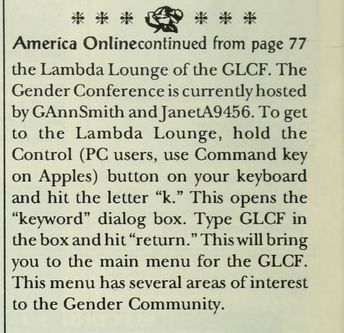
Article in TV Tapestry describing the exact keystrokes to connect to the Gay and Lesbian Community forum in order to participate in the Gender Conference, a scheduled online meeting for transgender AOL users.
It meant “explaining we just wanted a place to chat, as opposed to their assumption that any discussion of trans issues was inherently sexual,” said Smith, the former AOL moderator. “No, we just want a place where those of us who are trans can decompress about our days just like anywhere else.”
TG Forum was an early website with resources and community participation, and, a little bit later, a chat room. Software to create blogs, host discussions, or publish articles didn’t exist yet, so Fenton wrote the site’s code herself.
While TG Forum ran on the open web, and AOL on a proprietary platform, both had chat rooms that permitted anonymity. A user could observe, leaving virtually no trace. Or pick a screen name and try a new identity with minimal risk—a potentially life-changing opportunity for closeted trans people.
The World Wide Web’s invention in 1989 and its expansion into widespread use just a few short years later would transform these digital spaces for trans people. Early on, the web proved useful for gathering resources. Fenton said she built web pages for various trans groups and, with Cindy Martin and JoAnn Roberts, created a “trans super site,” that included the TG Forum.
In the late 1990s, the forum was archived onto a CD. At the time it provided access for people with sporadic internet, those who wanted to free up the lines, or those with a limited amount of minutes. Today, it’s a snapshot of a particular trans community while it was still growing.
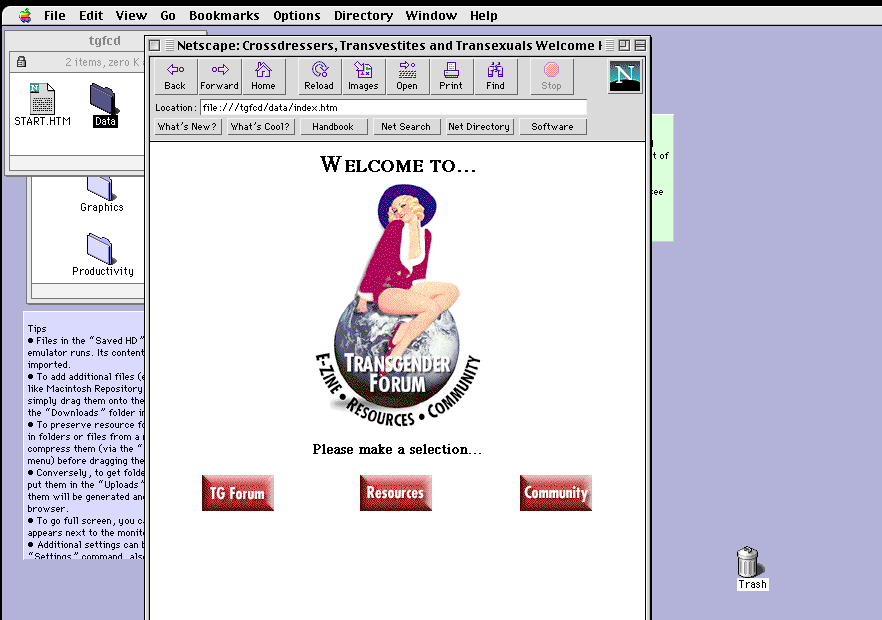
The CD showcased the community’s breadth—covering name changes, coming out, makeup, photography, trans history, and the emerging transgender rights movement—but also its limitations.
While internet access was growing among all groups, the contributors were mostly white. The nature of the information and community itself also skewed toward MtF transgender people (a label that’s mostly been superseded by “transfeminine”). Transmasculine users were present but rarer. TG Forum once described its FtM resources as “scarce but growing.” Susan’s Place, another popular forum, created by Susan Larson in 1995 and moderated by volunteers, also focused heavily on transfeminine users.
The relative absence of transmasculine views during this period was explored in “The Two Revolutions,” Griff-Dame’s academic account of the parallel rise of the internet and transgender activism. He quotes a writer in an online newsletter, “Surely, it cannot be true that I am the only techno-geek in the FtM world. Why is it, then, that I can find nobody of a like mind on the internet?” Griff-Dame’s research found a growing presence of trans men in the late 1990s and early 2000s.
While trans activism was building momentum during the 1990s and 2000s, trans people remained relatively invisible and outside transphobia was less of a concern for online communities. Moderators of trans forums were occupied with other problems, including intracommunity conflict and users eager to exploit systems in an era when online security was in its infancy.
The Web’s Influence
The web was starting to affect existing communities. AOL had created a bridge to an older communication network, Usenet, which hosted groups on myriad topics, including gender and sexuality but brought with it considerable baggage, such as spam. Usenet’s lack of moderation also fostered harsh exchanges, which carried over to transgender and crossdresser forums. Long-time activist Marisa Richmond wrote in 1996 that Usenet discussions were so toxic that she was concerned the vitriol would scare users away.
In the early 2000s, not finding a place that embraced both trans people and their partners, Helen Boyd and her wife Rachel Crowl formed the My Husband Betty forums, named after Boyd’s book. She describes the forums as filling a niche other forums didn’t. There were more partners of trans people and nonbinary people, she said, and less of a focus on transition how-tos that were well-covered by communities like TG Forum and resource-focused sites like Andrea James’s Transgender Map.
“One of the things I found was that a lot of the other advice for trans people was very individual – like, this is how you transition, here’s how you get a carry letter, hormones amounts, all that stuff was very individual,” Boyd said. “Nobody was talking about relationships. We used to say, the holistic trans person.”
Many of these communities no longer exist or are much less prominent. The AOL forums traded hands a few times. The My Husband Betty forums closed in 2019 after facing technical issues. TG Forum lives on but with occasional articles and user posts. Susan’s Place, which narrowly avoided closing in November 2025, retains a large user base but is less central than it was.
Since then, trans people have continued to build new communities. While online trans communities have long formed on large commercial platforms, these new communities are now even more likely to be on commercial platforms today. While this eliminates the need for coding a platform from scratch like Fenton did or even installing and configuring existing forum software like Crowl did, it also means the community has less direct control.
It also poses a question about historical preservation. Smith said that it would be technically possible to recreate enough of AOL’s software to bring these communities back to life, but the attempt she was aware of has fizzled out. While less of a technical lift on Discord—custom archival tools already exist—it is not as straightforward as it is for many websites. For Rae, who runs a community on Discord, The Trans Crossroads, that’s not necessarily a disadvantage.
“I do not view this as something that is something likely to be preserved. Honestly, I’m kind of OK with that,” said Rae, who asked not to be fully identified because of privacy concerns. ” Normally, I’m really into preserving as much history as possible. But, you know, in our case, [it’s] for a couple reasons. First the anonymity and second the fact that if our goal is to get information to people, the information gets out of date.”
Boyd and Crowl also opted to favor privacy over preservation. While web scrapers can preserve that vintage of web forum, very little of the My Husband Betty forums is on the Wayback machine, as she and Crowl made the decision early on to require a login.
Similarly, Fenton suggested that chats being more ephemeral prevented old conflicts and out-of-context messages from resurfacing. While it was feasible to keep text logs, few people did.
Most of the moderators and administrators I talked to experienced burnout or witnessed it in others. Often the cure was the same—time off. Research, much of it focused on either volunteers on modern communities like Reddit or paid moderators on sites like Facebook, found psychological distress has been common.
The churn of technology and our emerging visibility has meant our online communities have disappeared, evolved or been supplanted from decade to decade. Today, many focus more on societal issues, which speaks to the enduring relevance of our online communities. To those moderating trans communities of the present and future, Boyd has some advice.
“Yeah, I would say, burnout is easy,” Boyd said. “Do it out of love. I would say that that’s what I was motivated by. Love and knowledge.”
Alys Brooks is a writer, editor and tutor who has written about reproductive rights, LGBTQ+ issues, voting, and other public policy topics. She is a member of the Trans Journalists Association and lives in a housing co-operative in Madison, Wis., with her cat, Jax.





Throughout the 1990s I ran a nonprofit clearinghouse called the American Educational Gender Information Service. When the internet was made available I began reposting every piece of then scarce news, studies and information. The service was called Aegis News. It went out about twice a month, whenever I had a half-dozen or so items to share. By the end of the 90s it was going out daily with 30 or more items. It eventually evolved into Gender Advocacy Internet News and was managed for years by Penni Ashe Matz until her death and then, If I recall correctly, by Gwendolyn Smith. Those were heady days.
Don’t forget about Compuserve and the TG section in the HSX200 forum.