The Death of Renee Good, Queer Woman
The queer community of Minneapolis is dealing with the loss of one of their own as well as seeing their city under seige.
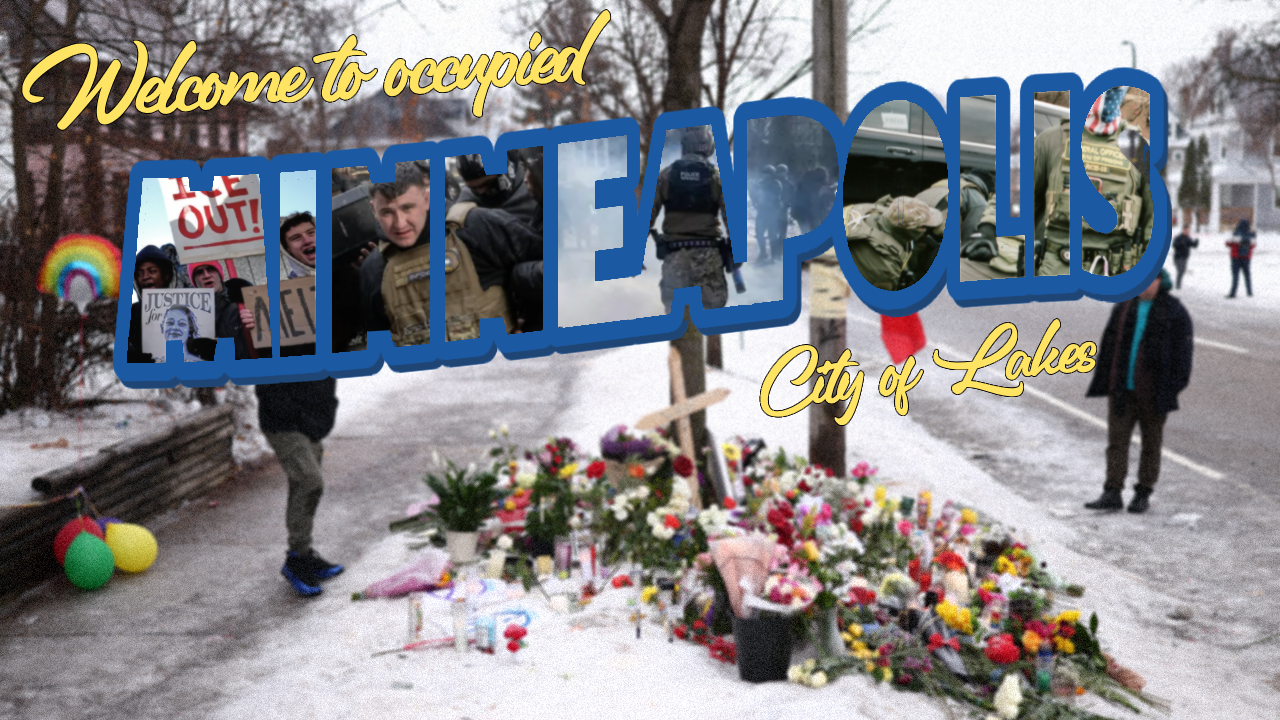
by Aly Gibbs
Be Good
In December, Immigrations and Customs Enforcement began Operation Metro Surge, their mass invasion of Minneapolis and St. Paul, Minnesota. Labeled “the largest immigration enforcement operation ever carried out” by the Department of Homeland Security, Metro Surge soon expanded to encompass the entire state.
On the morning of January 7, Renée Nicole Macklin Good was exercising her constitutional right to observe ICE activities. She briefly blocked a roadway while students were being dropped off at a dual-language elementary school around the corner. ICE likes to target families at schools, abduct children off the street, and even use them as bait in unlawful raids.
ICE Enforcement and Removal Operations Officer Jonathan Ross approached Good’s car and began filming her using his cell phone. Good’s wife Becca followed Ross, filming him in return, until two more ICE agents approached. They issued contradictory commands, telling Good both to exit her vehicle and also to leave the area, while one agent lunged to unlock and open her door. Good turned her wheels to the right and began to move forward, into traffic, when Ross drew his gun and shot her three times, once through the front windshield and twice through the driver’s side window, then angrily proclaimed, “fucking bitch.”
Good’s vehicle accelerated at speed, as often happens when drivers are shot (which is why police are taught not to do this), until it crashed into a parked car and light pole. ICE agents blocked off the scene almost immediately. A man identified himself as a physician and begged the agents to let him check on her; they said, “I don’t care,” and denied him access to Good as she lay dying.
Renée Nicole Macklin Good left behind her wife, her six year old son, and two children from a previous marriage.
The Trump administration hurried to administer propaganda with the aid of mainstream media. CNN made their best effort to smear Good as a troublemaker by connecting her to her son’s school board, which disseminated documents about lawful ICE observation and Constitutional Observer training. CBS, under despicable state propagandist Bari Weiss, reprinted blatant lies from unidentified sources suggesting that Ross was injured in the altercation. Even the New York Times’ analysis of video footage stated in no uncertain terms that Ross was clearly unharmed.
Minnesota Bureau of Criminal Apprehension agents began an investigation into Good’s murder the day it happened, but were sidelined by the FBI in less than 24 hours. Next, the Justice Department declared that Jonathan Ross would not be investigated for murdering Renée Good, but that they would be investigating her wife, as well as Minnesota Governor Tim Walz and Minneapolis Mayor Jacob Frey. Six federal prosecutors resigned their positions as Trump’s Justice Department pressured them to investigate Good’s family. Minnesota’s Attorney General, Keith Ellison, has sued the Trump administration to demand that ICE leave Minnesota.
In the wake of Good’s murder, most outlets barely mentioned her wife, Becca, who watched her die. They made no mention of Good’s queerness, and frequently labeled her son an “orphan,” despite the fact that he still has a mother. They referred to Renée as a widow, despite the fact that she had a wife. Trump himself referred to Becca as Renée’s “friend,” an age-old dog whistle meant to erase her queer identity.
Good’s butch presentation, in particular, drew the ire of conservative rage baiters like Adult Baby Diaper Lover fetishist Matt Walsh, who described both Renée and Becca as “enemies of the people.”
The message was both loud and clear: If you fail to demonstrate proper obeisance to lawless goons sent to terrorize your community, especially if you’re visibly queer, it’s acceptable for angry men to shoot you dead in the street. It’s a promise of violence new to most white Americans, but one that Black and brown Americans are intimately familiar with.
Talking to the Helpers
The Twin Cities have had a trying month, suffice it to say. By far, the most troubling period in the city's recent history, since the Minneapolis Police Department murdered George Perry Floyd, Jr., in May of 2020. Jackboot thugs under the command of the federal government are trooping door-to-door, asking after our neighbors. They’re carrying out chemical warfare on observers and protestors, exposing brave people to known abortifacients. They’re forcing drivers off the road, instigating dangerous car accidents, and beating locals for daring to watch them work. They’re occupying hospitals and taking people from emergency rooms, forcing pregnant migrants to ask on social media, “Where is it safe for me to give birth?”
Since I began writing this story, many more terrible things have happened. A man was shot in the leg by ICE, who immediately lied about how it happened. When neighbors arrived to observe the scene, ICE agents deployed tear gas against a family of bystanders and incapacitated their baby in the process. ICE are abducting and beating observers, or openly threatening them. They are denying attorneys access to their detained clients, and now saying they don’t even need a warrant to break into your home and abduct you.
It’s just too much to keep up with. Perhaps that’s by design. Maybe a single human body was not meant to indulge in this much trauma and heartbreak. Feeling overwhelmed, I decided that I needed to talk to people who were meeting this moment in some way, so I spoke to Representative Leigh Finke, a member of Minnesota’s Democratic-Farmer-Labor Party who represents District 66A in our state legislature. She is, let’s just say, no stranger to Donald Trump’s animus.
“I'm trying to be as helpful to the people in the Twin Cities as I can, and there's a few different ways that usually manifests,” Leigh said when I asked how she’s responding to ICE’s presence in the Cities. “One of them is helping locate people who have been detained; it's often the case that people don't know how to find a loved one once they have been arrested or detained. The second part is being responsive to the needs that come to me ... that looks like a lot of things: I get text messages that people need supplies, or that there's ICE coming into the district and to let folks know, it's all kinds of things and it's different a little bit every day. Making sure I know what I can do, what I should be doing, who I can be sending people to, all of these things are a part of the day-to-day here.
“The queer community, I think that we're on edge. We saw what happened to Renée Good when she was murdered for being in her car in a way that was frustrating to ICE agents, but since then we've continued to see and hear more targeting of people who are visibly queer. Lesbian couples have been getting targeted. This idea of gender-based violence and oppression seems to be a part of how ICE are moving through the world. They are using Renée Good's death as a threat. They are talking to queer people in a manner that targets their bodies, their appearance, their sexual orientation. It's right in front of us, and it's a part of the landscape of violence here. I tell people to take it seriously, to look out for yourself, to look out for each other and know that the people who are doing this will commit acts of violence against you unexpectedly. It was a 40 second encounter that left Renée Good dead.”
I asked Leigh if she had a message for those outside of Minnesota, and she said, “What is happening in Minnesota is much worse than your readers think it is. The pervasiveness of fear and intimidation and violence... it's very difficult to express how deeply it affects the communities that I represent. All across the Cities, all across the state, even Republican districts are getting people kidnapped off the streets. LGBTQ people are at a particular risk ... but really what this is about is protecting our Black and brown neighbors from abduction and deportation, and queer people are gonna fight that, and I'm proud of that fact.”
I also spoke to Kat Rohn, Executive Director of OutFront Minnesota, the state's largest LGBTQ+ advocacy organization.
“I am, like many of us, heartbroken at the horrific tragedy of the death of one of our community members, but also just the ongoing and everyday occurrences of families being ripped apart and our community life being disrupted,” she told me, when I asked how they’re feeling in the wake of all this chaos. “Schools are closed, businesses are closed, everything about our day-to-day life is interrupted by a federal occupation that seems to have no regard for the law and the constitution.
“Organizationally, we're trying to respond in a lot of different ways. That looks like holding a community care space not too long after Renée's murder, and just giving space and support to community members. I came together with a number of our other LGBTQ organizations to draft up a shared statement and calls to action that we published the Friday after Renee's death, and that has now garnered signatures from, like, 75 organizations here within the state, and all the way to national level orgs. That's been something that we have stepped up many times in these moments of crisis; when our Somali communities were being targeted, our organizations put out shared statements of solidarity and support. Again and again, we try to come together as communities to give folks both direction and voice.”
I asked, too, what they’re seeing from other queer and trans folks in our community.
“What we are seeing is that queer and trans folks are deeply intertwined in the work of protecting our communities, and that's been true in and out of this particular moment, but folks are stepping up across different layers of communities in different ways. It's not just organizations and formal groups, it's every layer of our community figuring out how to get involved in some way, whether it's delivering groceries to a neighbor, observing on a street corner, or just figuring out how to touch base with the people around you. Now is a time where that broader sense of community is what's really holding us through a moment of unknown duration.”
I expressed to Kat that, in the last few weeks, I’ve come to understand how people (New Yorkers, for example) develop a sense of pride for their city. She agreed wholeheartedly.
“Minnesotans love to hold a sense of pride about our place and our communities ... I think being really intentional about ensuring that we are talking about our immigrant communities and our friends and neighbors, in this moment, has been crucial. I think it's a demonstration of the strength of solidarity, that our immigrant communities are not standing alone, and our LGBTQ communities don't have to stand alone, either. We've had folks show up for us in times of need, this is a time where we're showing up for our neighbors, and we know that's part of how good organizing happens.”
Where From Here?
I’m not ashamed to tell you that I am so scared. I’ve never been so frightened, for so long, in my entire life, and mine hasn’t exactly been charmed. Every fifteen or twenty minutes, I consult ICE Out to see if anybody’s reported federal agents anywhere near my home. When I’m in the kitchen, I can’t help but look out the window, watching up and down the street for signs of trouble. I prepare myself, mentally and emotionally, to rush outside and document a stranger if they’re being abducted, to ask their name to pass along to legal aid groups, to make sure my neighbors know the trouble has come to our doorstep. I hope I am brave if I’m given the opportunity, but for now, I’ve spent most of the month worrying and crying.
Fortunately, there are heroes beyond counting in Minneapolis and St. Paul. Will Stancil is on the streets chasing ICE agents back to their compound in his Honda Fit every single day. Local business owners all over are telling these Gestapo bastards, in no uncertain terms, that they are not welcome here. Everywhere ICE goes, there are a dozen or more hometown heroes recording, reporting, and blowing whistles; alerting everybody to their presence, making it as difficult as possible for them to do their “jobs.” Many of the local reports on ICE presence are written in Spanish, because the people most likely to be targeted are taking to the streets and delivering the news:
We will not stand idly by while you terrorize and abduct our neighbors. We will not allow you to operate unobstructed. We will not break, even as you turn our city into an active warzone. This is our home. You are not welcome here. Get the fuck out.
Aly Gibbs (She/They) is a trans writer who reports on news important to the queer community.