It started with a breakfast sandwich on a January morning. Jessi Holleran (he/they) and their partner stopped in for sandwiches and coffee to go from the prosaically named Italian Bakery in Lewiston, Maine. Their plan was relaxed, a bite to eat paired with a trip to the public library, taking advantage of the break between snowstorms to get out and about their small, working class city. Then Jessi spotted the unmarked car.
“We saw an unmarked cruiser with a guy, and it looked like he had a facemask on. I’m like, That’s ICE right there,” Holleran told me a few weeks later, in the office of Equality Maine in downtown Portland, where they work as the communications manager.
“They were waiting outside of the Basilica [of Saints Peter and Paul], because there was a funeral happening,” Holleran continued. “And I was like, Oh my god these people are literally gonna abduct somebody in the funeral procession.”
Holleran and his partner didn’t continue to the library that morning. Instead, they got in touch with the local network of ICE watchers. The city’s network of ICE watchers converged on the Basilica in cars, circling the block. The line of vehicles alerted those in the church that ICE was probably present, and made the route between the parking lot where the suspicious car was waiting more complicated to traverse. As time passed and the vehicle train persisted, the suspected ICE vehicle moved on without detaining anyone.
Holleran is far from alone, as a trans person who has joined efforts to protect immigrants from ICE activity. (Note: Although paramilitary anti-immigrant forces may include agents from several federal agencies, for simplicity they have come to be collectively referred to as ICE.)
In news stories describing how Americans are fighting back against the transformation of immigration enforcement agencies into a kind of secret police, trans and queer people are everywhere and nowhere. The name of Renée Nicole Macklin Good rang out across the country, the first ICE killing to gain national attention, in part because Good, unlike previous victims, was both a citizen and white. Good was also a visibly queer woman, but her queerness was never a focus in the mainstream press coverage of her killing.
In Texas, two trans women are among eight protestors recently convicted on charges of supporting terrorism, in a case that threatens the bedrock principle of free speech in the US. Whether trans women were intentionally targeted by the administration and the fate these women face in a men’s federal prison under an extreme anti-trans regime have been all but absent from mainstream US news reports.
Trans communities have been organizing against ICE since Los Angeles became the first major hotspot for intensive ICE incursions in June of 2025. In mid-January, the Bangor Daily News reported on plans to bring intensive immigration enforcement to Maine. ICE activity began in earnest later that month, primarily in Portland, the most populous city in the state, and Lewiston, a smaller working class burg about an hour away. Both have sizable populations of immigrants from East Africa, including Somalia.
In February, I spent a week commuting between Portland and Lewiston, meeting with organizers and volunteers who’d participated in efforts to protect immigrant neighbors from ICE. I wanted to see whether queer and trans communities were at the heart of organizing against Trump’s police state, and if so, why?
A Queer Latine Mainer Advocating for Justice
Queerness and whiteness aren’t synonymous, of course, a truth exemplified by Crystal Cron (she/they), the queer Latine founder of Presente! Maine. Presente! is a mutual aid organization that got its start delivering food to undocumented communities in Portland during COVID.
I’d been trying to meet with Cron since my first day in Portland, but when we finally connected it was by phone. I was on a train heading back home to Boston as Cron described what she understands as the connections between climate, racial, immigrant, indigenous, and trans justice. I could hear the peal of young voices behind her as we spoke, “They’re all tied up together,” she told me, “And those with the most to lose are often the ones risking it all.”
The ICE surge in Lewiston and Portland was dubbed “Operation Catch of the Day” by the meme-poisoned minds in charge of the US federal government. Thinking back, Cron says it was early on the morning of Tuesday January 20, when they awoke to the first report of ICE activity.
“The first thing I saw was a message from a school watcher, at their home in the neighborhood, saying I’m seeing ICE, three vehicles and five agents, outside,” Cron said. “She had asked what was the nature of their presence there, they said they were conducting a targeted operation. She asked if they were armed, they said ‘of course.’”
That morning, and for hours every day over the next two weeks, Cron worked with a core group of organizers who she described as “either BIPOC or queer, and many both” to field reports of ICE activity, send out watchers and verifiers, document activity, support community members, and try to get ICE to leave their city alone. Though Cron’s focus was Portland, her work overseeing and dispatching observers was similar to what led watchers to converge on Holleran’s location near the Basilica in Lewiston, and to the work of many other networks throughout the country.
That January morning was not the real beginning, though, Cron says. Efforts to organize an emergency community response started a year earlier, when Donald Trump began his second presidency. Or, if you like, it may have started even earlier, when queer and immigrant rights groups began creating a diverse coalition that, organizers say, has worked to protect members of Maine communities across identities, with an eye on building power for the long term.
“Since January 2025, we’ve been preparing, and studying, and planning this robust community defense ecosystem,” Cron said. “We knew from the beginning that it was only a matter of time until threats were escalated in our communities, whether that be ICE, or whether that be targeting trans students.”
Trans students, along with other queer young people, have mobilized through a group with which Presente! works closely, Portland Outright.
Portland Outright is a youth-led, queer organization that has fought the incarceration of young people and otherwise expanded the boundaries of traditional LGBTQ+ advocacy. As the Trump administration escalated its attacks on trans youth, Outright and Presente! developed a network of people, often queer parents and parents of trans youth, to respond to incidents at school when queer and trans youth came under threat. Known internally as the Maine School Defense Network, the structure the groups built was similar to the observer networks that would later form around the country in response to ICE.
Presente! and Outright leveraged this existing network of school watchers to include the reporting of ICE activity among the types of incidents that they were monitoring. It was one of these very school watchers whose report of ICE activity Cron awoke to on January 20.
Monitoring ICE felt like a natural outgrowth of the collaboration that already existed, said Osgood (they/them), the nonbinary director of Outright. Osgood described their primary role during the surge, wryly, as wrangling fresh volunteers from Portland’s white queer community who joined the work with feelings of intense zeal and personal calling.
“It was, frankly, the best and the worst of white queer stuff,” they said. “People responded really fast. They were really ready to throw down. Some of that felt chaotic, some of that felt like people were in their crisis energy. But also, what we saw was people who really wanted to be put to work.”
For her part, Cron described Outright’s efforts to organize members of the white queer community in Portland as critical to their shared work.
“Part of it is the practical strategy of defending students from ICE at school,” she said. “But the other piece is helping people understand themselves as part of long-haul movement work.”
The Whitest State
Of all the states in the US, Maine has the distinction of being the whitest, with fewer than 10 percent of inhabitants belonging to a non-white ethnic group, according to the US census. It’s also one of the oldest population states, behind only the District of Columbia and Vermont in the percentage of adults over the age of 18. Maine, like the rest of the US, has nonetheless been diversifying, with both Black and Latine populations having grown in between the census years of 2010 and 2020.
Why was Maine targeted for intensive immigration operations? The previous actions were more associated with large cities, particularly ones in liberal states, or deep red areas. Perhaps the state was chosen because Maine’s governor, Janet Mills, had openly defied Trump in ways reminiscent of Minnesota’s Tim Walz, Illinois’ JB Pritzker, and California’s Gavin Newsom, all states where heavy ICE buildups occurred. It’s also plausible that the state’s whiteness led the race supremacists in Trump’s government, figures such as Steven Miller who is believed to be a driver of immigration policy, to imagine that Maine’s majority would welcome an influx of masked secret police kidnapping people based on skin color.
If Maine’s demographics factored into the decision to mount the escalation, however, white Mainers refused to play along. The state proved no more willing to see neighbors being kidnapped and assaulted by masked thugs than whites in Minneapolis, MN or Portland, OR. From the ICE Watch signs tacked to trees and telephone poles on the streets of Portland to the constant political attack ads tying Republican Senator Susan Collins to the ICE raids, it was obvious that ICE’s actions had been deeply unpopular.
Meanwhile, many Democratic politicians attended anti-ICE protests and events, including the mayors of Portland and Lewiston, as well as Graham Platner, one of the Democratic challengers seeking Collins’ seat. Also at the protests? Many, many people who were queer or trans.
Emerie Biederman (they/them), joined one of their partners and some queer friends to attend a snap protest in Lewiston on January 24, the day ICE agents killed Alex Pretti in Minneapolis. While Biederman lives in Lewiston, their friends had driven 50 minutes from Waterville (practically next door, in Maine terms) to register their outrage at ICE’s actions.
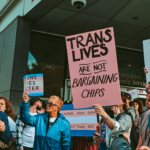
In Biederman’s telling, three demographics showed up in numbers for the protest, which drew about 1,000 people, only half of whom actually fit inside the Agora Event Center.
People of color, immigrants or children of immigrants, were out in force. Then there were mainstream liberals, people Biederman described as “older white people who show up and hold their signs.” The third notable cohort was “a bunch of queer people organizing and trying to help out and enlist people in school watches and mutual aid.”
Holleran of Equality Maine was at the Agora as well. He described the crowd less colorfully, but agreed with Biederman’s taxonomy. “I know that the majority of people organizing in Lewiston are queer or trans,” they said. “Of the people I saw that day, I would say the majority of people who were around my age, in like their 30s, were probably queer, if I can make that assumption.”
The experience of growing up queer in rural Maine is often isolating, though a live-and-let-live attitude largely predominates, according to Biederman. They shared that a joke people make about racism in Maine is that white Mainers don’t see any racism because they go their whole lives without seeing anybody who isn’t white. But there are other jokes, occasionally. Nastier ones, insinuating Lewiston is dirty or dangerous because African immigrants have settled there. While Biederman wasn’t exactly surprised that Mainers had so roundly rejected ICE, they felt that it was notable and in need of explanation.
“Many of these immigrants were born here or grew up here, they went to school here, and so people look at the people who are getting disappeared and see them as Mainers, and they’re thinking we need to take care of our own,” they said. “You do also have people who think the only type of Mainer is a white person, but I don’t think that those people are the majority. I think the majority of Mainers want to protect their community.”
Trans and queer people are also reflected in the other targeted group in this crisis, meaning immigrants. At Presente!, trans migrants are among the vulnerable populations the group serves. Crystal Cron described the lives of migrants who had fled violence and persecution due to their identity, only to find the same treatment in the US.
“A big part of the community that we serve, and that we’re a part of, are trans Latinas who have fled from their countries of origin due to safety issues and persecution,” said Cron.
“They don’t always have the support of the broader [immigrant] community, who are often very conservative and religious,” they continued. “They have to either hide their identity or live in isolation, not having access to a lot of support.” (Though I tried, I did not succeed in speaking to trans or queer immigrants, documented or undocumented, for my reporting.)
‘A Door That’s Partway Open’
Efforts to protect the community have taken many different forms. While organizers like Cron and Osgood organized people in immediate response networks, others (including some at Presente!) have worked to meet the basic needs of immigrants afraid to leave their homes, lest they be profiled and arrested. Holleran created an online form connecting immigrants in need of rides with community members willing to drive them. Many of these drivers were, like Holleran, transmasculine.
And, according to Cron, a group of three or four transfemmes were among the most consistent responders in the observer network overseen by Outright and Presente! One transmasculine guy from Portland who preferred not to share his name worked as a dispatcher on one of the rapid response Signal group chats. Jeremy, a trans man in the Lewiston/Auburn area who preferred not to share his last name, delivered groceries to families hiding in houses with their windows boarded up.
At every level of organizing, and in every role, trans and queer Mainers showed up, a microcosm of trends that seem to hold across the country.
A robust, unsung queer and trans presence has been a feature of anti-ICE organizing far beyond Maine, according to State Rep. Leigh Finke (she/her) from Minnesota. Finke, a trans woman representing St. Paul, is championing two bills that seek to shut down secret police tactics by federal immigration authorities, requiring that agents’ cars be clearly marked and banning face coverings except for public health reasons. She’s also been in contact with organizers opposing the violent repression, kidnappings and killings of peaceful protestors by ICE in the state. She says that, as in Maine, many of those she sees doing the work are trans or queer.
How many? “Certainly not a majority in Minnesota,” said Finke, “But only because we had 20 or 30 thousand people taking the constitutional observer training. But transgender, nonbinary people, and queer people are on the front lines. Especially trans people, who are facing the absolute imminent threat to our community’s right to exist.”
The threats faced by the trans community are likely known to most of those reading this piece. The Trump administration came after trans young people’s healthcare, using threats of investigations and funding cuts to force hospitals to abandon trans young people even in Democratic states. Trans people who were serving in the military have been expelled and, in many cases, denied the benefits of an honorable discharge. The administration forcibly outed trans people on government IDs, banned us from using appropriate restrooms in government facilities, and removed protections from sexual assault in prison. They’ve also erased the letter T from LGBTQ on government websites, and taken Marsha P. Johnson and Sylvia Rivera out of educational materials relating to Stonewall National Monument. Trump enshrined a definition of man and woman that excludes trans people in an executive order that describes trans people’s existence as a nefarious ideology. Long as it is, this is a partial list.
And yet, time and again, when you look at which Americans are showing up to support immigrant communities and oppose kidnappings and violence targeting residents with black or brown skin, you find that trans people, often ones with no direct connection to immigrant communities, are there. I asked everyone who’d speak with me why they thought the LGBTQ community in general, and trans people in particular, were mobilizing so extraordinarily.
“I think this administration has activated people and fired them up,” said Holleran, speaking about seeing an influx of volunteers who’d never participated in mutual aid before. “It’s kicking the hornets’ nest—people are willing to do things that they’ve never done before in order to just feel some semblance of, like, control in all this chaos.”
“The thing about queer and trans people, is that even if they’re still learning about racial justice, they have a door that’s partway open,” Osgood said. Personal experiences of injustice and marginalization, they and others suggested, open the door to empathy for other targeted groups. Queer progressives’ recent cultural interest in race and antiracism, even though it may at times seem shallow or based in a white savior mindset, form a starting place whose potential is only beginning to be tapped.
Setting individual awakenings aside, several people suggested there was another reason trans and queer people have been so prominent among activists opposing ICE: It’s the legacy of solidarity building during the Black Lives Matter movement, particularly when protests against police violence erupted after the murder of George Floyd.
For Osgood and Portland Outright, a reorganization in 2013, at the dawn of the Black Lives Matter movement, refocused their organization on the connections between queer liberation and racial, economic, and other gender justice work.
“The work that led us to being able to show up so well during the ICE surge actually started pre-2020, because we did a lot of racial justice organizing,” they said. “2020 was a moment in which we’d done some of this foundational trust building that allowed us to show up in that moment.
The protests against police violence in 2020 were, they said, “the first time that we saw a lot of the people who were putting their bodies on the line in solidarity were queer and trans young people.” Outright created a bond fund for queer and trans youth who faced arrests during protests against police, and worked to strengthen their connections with groups serving non-queer communities, such as Presente!, in order to be ready for the next moment of crisis.
Cron agrees that the slow process of building coalitions was fundamental to Presente!’s ability to mobilize in the face of the ICE surge. The ICE response, she said, was one moment in a movement-building process that predated the surge or even the present Trump administration – one that will continue and outlast Trump’s presidency.
“Even though what happened is awful and we don’t want to have to prepare for such things, we find the opportunities to bring people into this kind of thinking, into this movement that we’re building,” she said. “If there are any points of joy or victory, that’s one of the biggest ones.”
In Minneapolis, Finke says she sees the same dynamic, describing a “strong integration of our justice movements” rooted in the solidarity building during Black Lives Matter.
“Black Lives Matter in Minnesota was always very inclusive of trans and queer people,” she continued. “So there is an acceptance and readiness for trans people to be at the front of this work. It’s incredible to see.”
These deep connections between organizations serving diverse communities are why organizers say they don’t believe the solidarity with immigrants they saw when ICE were at their most active is a flash in the pan. At Outright, Equality Maine, Presente! and other leftist organizations, activists say they’re connecting, strengthening, and building for the long haul.
Says Biederman, “We might be lulled into a false sense of this isn’t happening anymore. A lot of people might put it in the back of their brain and forget about it. But, I think the reason why this movement happened – of everyone trying to stand up for other people – is because that’s just how it is a lot of the time here.”
“It is a very common thing for two neighbors who live right next door to each other to not talk for 20 years, and then the second that one of them needs help splitting wood the other one will come over and bring an axe with him, and help him split that wood.”
In Maine, New England reserve doesn’t preclude caring for your neighbors.
Evan Urquhart is the founder of Assigned Media.