On January 8, a story for CBS News referred to athletes banned from participating in girls sports teams as having been “assigned male at birth.” Three days later, another CBS story on the same topic, but by a different reporter, used language favored by anti-trans activists instead. The piece referred four separate times to students’ “biological sex at birth.”
Was this merely a style difference between the individual reporters or their editors? Unlikely, according to reporting in The Wrap, a site covering media and entertainment business news. Corbin Bolies reported there yesterday that a memo from the network’s senior director of standards and practices, Tom Burke, directed CBS reporters to “use the term biological sex at birth” with “no quotes needed” in stories relating to the Supreme Court case over trans athletes banned from women’s sports.
According to Bolies, Burke had until recently suggested reporters follow the style guide of the Trans Journalists’ Association, which recommends against use of the phrase “biological sex” as imprecise and frequently used in contradictory ways.The recent installation of Bari Weiss as editor-in-chief at CBS. Weiss’ is the most likely impetus for the change. Weiss’ right wing Free Press blog, now itself a part of CBS News, regularly champions anti-trans causes.
Assigned Media has covered the ways news media report on issues related to the trans community from day one. We’ve chronicled how far-right talking points migrated into legacy media coverage, resulting in an environment where falsehoods and bad-faith talking points frequently overwhelm the basic facts relating to trans people’s bodies, healthcare, and lives. And this year, we’re launching our most ambitious media tracking project yet.
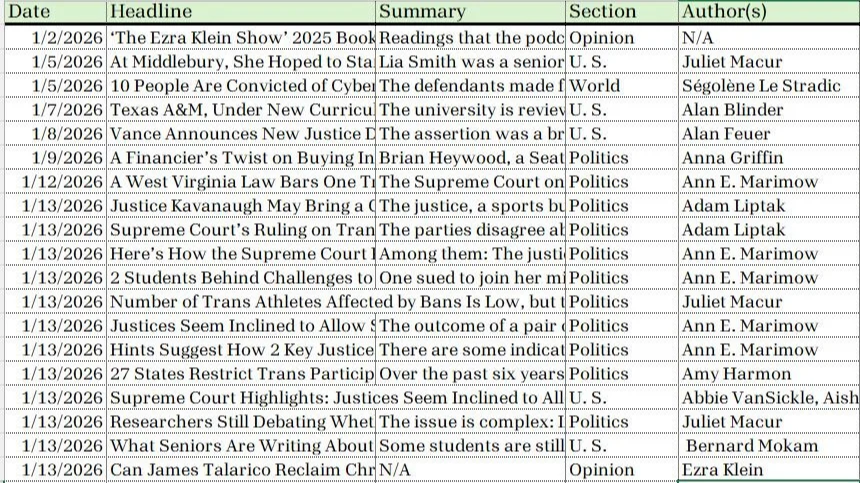
The 2026 Trans News Tracking Project seeks to catalogue every story or transcript in 2026 that references trans people, trans medical care, or the political fight over trans rights across eight major legacy outlets and two independent news organizations. Those publications are The New York Times, The Washington Post, the Wall Street Journal, CBS, NBC, ABC, NPR, the Associated Press, Mother Jones and the 19th.
For our legacy publications, we started with three national outlets that have undergone politically driven newsroom changes: The leadership of The New York Times, The Washington Post, and CBS have each reportedly pushed coverage to the right. To those, we added five comparable legacy outlets including one newspaper thought to lean right, the Wall Street Journal; the newsrooms of the two other major broadcast networks; along with the Associated Press and NPR. (We are not including CNN due to difficulties with reliable search results both on their site and using Google’s site specific search.) We also added Mother Jones and the 19th, smaller, more progressive and inclusive newsrooms whose coverage of trans issues has distinguished them in recent years.
Every day or two Assigned Media will conduct searches of each website’s contents for the words trans, gender, and sex, attempting to collate stories that reference topics like gender ideology or gender affirming care even if they don’t use the words trans or transgender themselves. In addition to the headline, summary, and author’s name, we’ll also note the section of the news outlet where it ran (for example, “politics” or “entertainment”), the sources who are quoted, whether any trans people are among those sources, and any specific phrasing outside of quotation marks used to describe trans people, their bodies, their identities and their healthcare. We see this effort as a compliment to other media tracking work, such as TJA’s Trans News Initiative. Our tracker drills down into the details of how some of the most influential news organizations in the U. S. cover trans news.
Although the tracker has only been running half a month, it’s already provided a fascinating look at how U. S. newsmedia covered trans athletes at the Supreme Court. In short, we found The New York Times owned the story with more extensive coverage than any other news outlet.
On January 12 and 13, NYT published 11 separate stories on trans sports bans being heard at the Supreme Court. Three reporters each wrote more than one story each, with three more writing once or contributing reporting in some way.
The paper has been frequently accused of allowing anti-trans bias to color their reporting, and this coverage seemed to continue that trend. In one story, by Amy Harmon, the phrase “biological sex” appeared outside of quotes. Another piece on the special insights Brett Kavanaugh has into women’s sports due to his coaching girls’ basketball was notable in what it didn’t say: The warm picture of Coach Kavanaugh did not include and quotes from people representing the trans supportive side of the case, but a piece centered on Becky Pepper-Jackson, one of the trans athletes suing to be allowed to compete in high school track and field, included lengthy quotes from John McCuskey, the West Virginia AG supporting the ban.
In comparison, the Washington Post wrote four news stories on the trans athlete cases at the Supreme Court. This was supplemented by two opinion pieces, both opposing trans inclusion in women’s sports. The Associated Press had three stories, as did NPR and NBC, and the other outlets each published two.
Of all the outlets in our tracker, only the Associated Press mentioned trans people in another story during those two days, in a piece on Mackenzie Scott’s gift of $45 million to the Trevor Project. (AP stories that run in other outlets are counted only in our tracker for AP). A story by CBS covering Scott’s gift to the Trevor Project did not contain the word trans.
Is the New York Times dominating coverage of the trans community, or was the gap between them and other outlets on the recent SCOTUS case a fluke? Will CBS routinely leave out mentions of the trans community out of stories other outlets don’t? How are news organizations style guides evolving, and is there reason to believe that bias is driving the decisions on how reporters write? We plan to answer these questions with a series of stories and data visualizations throughout the course of 2026. Media watchers, stay tuned.
Assigned Media is one hundred percent supported by our readers. Become a member today and get a members-only essay every Thursday.