by Evan Urquhart
In 2025, the US President disappeared 3 million Americans from government records, and that was only the beginning. Redefined via executive fiat as carriers of a dangerous ideology, trans people became non-persons in the eyes of the government on Trump’s first day in office, a prelude to a campaign to strip them of equal rights and protections from discrimination that has insinuated itself into every corner of trans life. From traveling the world, to using the bathroom, to seeing a doctor, the scope and rapidity of the losses have destabilized a community already existing on the margins of society, aided and abetted by elites and institutions in every social arena.
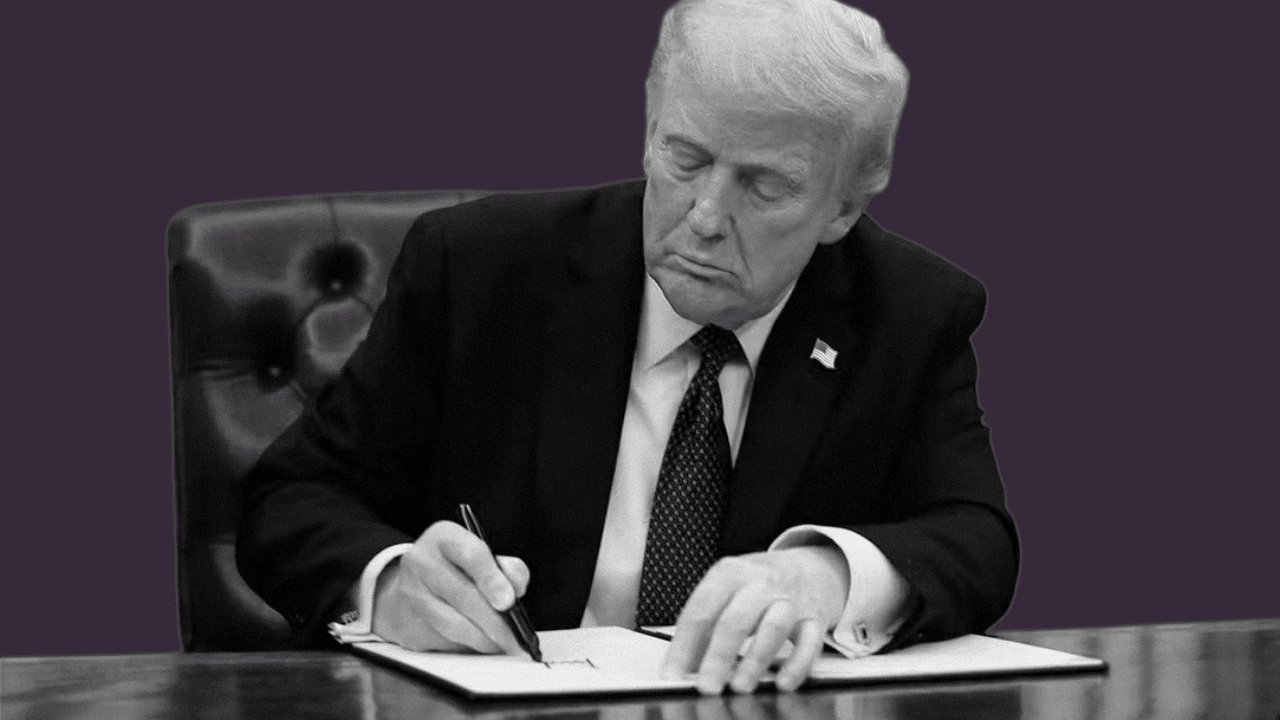
While there are hopeful signs to be found in the resistance and solidarity of the community, and in Democratic politics, there’s no sugarcoating what a terrible year 2025 has been, and it all started on January 20, the day Donald Trump retook the presidency. An atmosphere of defeatism and apathy blanketed the blue parts of the country as a convicted criminal, an avowedly dictatorial president, signed executive order after executive order demonstrating his intention to remake the US government into a regime of one-man rule. One of those, titled Defending Women from Gender Ideology Extremism and Restoring Biological Truth to the Federal Government, became the justification for much of the campaign to wipe trans Americans from government records and strip them of constitutional rights and legal protections.
Restricted From Safe Travel
Within three days of the inauguration, the right of trans people to travel freely out of the country was compromised by newly minted Secretary of State Marco Rubio, who ordered the State Department to freeze passport applications requesting an X marker in the gender field. All passport applications requesting a change to the gender marker were frozen shortly afterward, indefinitely depriving those who’d requested them of the ability to leave the country, until a process for issuing ideologically clean passports (ones reflecting a person’s birth-assigned sex regardless of transition history) was eventually rolled out.
The policy represented a drastic departure from the status quo in the US since 1992, when trans people were given an avenue to update the gender marker on their passports during the presidency of George H.W. Bush. That was just 15 years after passports began listing a passport holder’s gender in 1977.
The ACLU challenged the administration’s passport policy in court. They soon won a stay from a district court judge, who found the new policy was likely discriminatory and unlikely to survive legal scrutiny. This allowed trans people to apply for or renew passports under the previous rules. Then, in November, the Supreme Court issued an emergency ruling allowing the anti-trans passport policy to go back into effect. Currently, Americans who apply for a passport or passport renewal are issued a passport that reflects the Trump administration’s opinion of what their gender should be.
Although the most common route to determining the administration approved gender of an applicant is a birth certificate, birth certificates can be changed in most US states. The administration reserves the right to make their own determination, using whatever documents or records they prefer.
While many news stories have presented the new passport rules as a question of trans people feeling respected and validated, the real stakes are much greater. For trans people who transitioned long ago and are typically perceived as cis, a document with the wrong gender could imperil their safety by outing them as transgender in hostile countries or by leading authorities to suspect fraud. Having mismatched documents, however a person is perceived, may also lead to suspicions of fraud. The passport rules therefore impede trans people’s ability to travel without undue government interference, a constitutionally protected right.
The trans community has watched developments around passports and legal documentation closely, alert for any signs that the campaign to restrict trans people’s freedom to travel will expand to invalidate passports of trans people with updated gender markers issued prior to these policy changes. While no action has been taken yet, a change to the State Department website threatens the potential for future government action invalidating passports with an X or changed gender marker.
Stripped of Honor, Forced From the Military
In theory, the president’s role as commander in chief is constrained by the US Constitution. In practice, an increasingly partisan, conservative-dominated Supreme Court repeatedly placed a thumb on the scales of justice to allow policies to go forward even though lower courts had judged them so obviously illegal that justice demanded a stay in their implementation. The treatment of trans members of the military by the president and Defense Secretary Pete Hegseth are among the most egregious examples of the court’s role in disregarding any pretense that trans people have equal rights under the law in the second Trump presidency.
The purge of trans service members began with the Defending Women executive order on January 20 and was followed up on January 27 with another executive order explicitly directing the secretary of defense to ban trans Americans from serving in the military.
Stating the armed forces had “been afflicted with radical gender ideology to appease activists” the order, titled Prioritizing Military Excellence and Readiness, was thin on specifics and left implementation to Hegseth. However, it was clear from the start that the intent was to go much further than an earlier trans military ban from Trump’s first presidency. This time serving members of the military would also be targets, with language in the order hinting that trans troops would not be considered to have served honorably.
By late February, the hope that any trans service people could remain in the military in some manner was removed. According to the Associated Press, a memo to leaders in the Defense Department on Feb. 27 directed them to create plans to identify the roughly 4,200 troops who’d been diagnosed with gender dysphoria, and remove each and every one of them from service. Troops were given a choice between leaving voluntarily with an honorable discharge and some compensation, or being removed.
This total purge was challenged in court, with multiple judges siding with trans service people who had been serving with distinction, saying that they did not believe the law allowed the administration to discriminate against them. However, by May, an emergency order from the Supreme Court had allowed the purge to go forward.
The implementation of the purge has been exceptionally cruel, with seemingly every effort made to deny trans people who served in the military the benefits of their service. Trans troops have been denied access to resources for troops transitioning to civilian employment, forced to misgender themselves, denied early retirement, and trans veterans have lost gender dysphoria treatment from the VA. They’ve even been forced to scratch out the words pronoun, gender, diversity and inclusion from workbooks during their separation process. Perhaps most shocking is that trans officers who leave are being given a discharge code that flags them as unfit for security clearances, greatly limiting their future employment options. The code is the same one previously used for members of the military expelled for homosexuality.
Trans people in the military are in a unique position, having been rewarded for their exceptionally close alignment with mainstream US values and policies with some of the harshest, most disgraceful treatment by the US government of any trans cohort.
Barred from Accessing Necessary Medication
The loss of gender-affirming healthcare did not start with the second Trump administration. A lengthy campaign to undermine the standard, scientifically backed treatments for gender dysphoria in young people led to increasing red state bans on treatments like puberty blockers and cross-sex hormones for trans youth, and only trans youth, starting in 2021. In July, the Supreme Court ignored overwhelming medical evidence, the text of the ban being challenged, and prior precedent on sex discrimination to declare that bans singling out trans children were constitutional.
Starting even before the decision in Skrmetti, the Trump administration took a variety of steps attempting to impose a care ban on the entire country, devastating families who’d fled state bans to ensure their children’s healthcare could continue. Adding to their devastation has been the cowardice of many hospitals and other healthcare providers who chose to end care rather than stand up for the legal rights of their doctors and patients.
The process of accessing medical transition for a minor has never been easy. Families must first come to the decision to speak to a specialist, something that usually comes after the child has had extensive therapy and the parents have done a lot of soul searching. Specialist clinics then commence a period of evaluation, review, and discussions with both the child and the family to ensure that medical transition is the right step for the child. Despite widespread insinuations that children were rushed into treatment, reporting by Reuters found fewer than 15 percent of children who were diagnosed with gender dysphoria in the US received any medical intervention for it.
On January 28 President Trump signed an executive order titled “Protecting Children From Chemical and Surgical Mutilation,” that declared youth treatments for gender dysphoria “a horrible tragedy.” The order called for a review of the evidence, while also stating the desired conclusion. Robert F. Kennedy Jr., Trump’s Secretary for Health and Human Services, published a report in May that purported to be such a review. The report, which claims to be a review of the evidence, instead spends most of its 280 pages opining on topics relating to trans identity, including whether America’s first trans celebrity, Christine Jorgenson, was really a gay man. The HHS report was later revealed to have been authored by a mix of activists and academics, none of whom had any expertise with gender medicine, and all of whom had a prior record of ideological alignment with the administration. Despite the clear similarities between Kennedy’s approach to youth gender medicine and his approach to vaccines, autism, supplements, etc, news coverage of his attacks on science has generally omitted this entire area.
On the basis of this report, Kennedy stated in November that he would cease Medicare and Medicaid payments to hospitals that continue to offer the treatments, a de facto (and almost certainly illegal) ban on youth trans care nationally. In mid December the ACLU announced it would sue the administration over this policy, and later in the month 19 states announced their own lawsuit over the policy.
Erased From Records, Lost to Research, and Banned in the Classroom
The regime’s attacks on the trans community were never confined to specific policy goals. Instead, each formed a small part of a vast ideological project to erase trans people’s long history of existence, and their more recent history of widespread acceptance. These goals were clearest in the efforts to take down websites, cancel research, and literally re-write history such that trans people were no longer acknowledged to have ever existed. From the classroom to the laboratory to public health messages, the word trans has been excised, replaced with euphemisms aimed at casting trans people as enemies of America.
The effort started in late January, when reporters noticed that public health websites maintained by the government had been pulled from the web, part of a hasty effort to comply with the Defending Women executive order which officially defined trans people out of existence.
According to PBS, content that went dark on January 31 included “contraception guidance; a fact sheet about HIV and transgender people; lessons on building supportive school environments for transgender and nonbinary kids; details about National Transgender HIV Testing Day; a set of government surveys showing transgender students suffering higher rates of depression, drug use, bullying and other problems.” Information on the number of trans people in federal prisons also vanished, as did whole research databases of public health surveys which included questions about trans identification.
Some of the health information was later restored by court order after a judge found that many doctors relied on the information in the downed websites to treat patients. Other information was never restored, such as a Park Service page on the life of pioneering trans activist Marsha P. Johnson.
The bowdlerization of history, education and public health resources to suit the regime’s anti-trans ideology was just the beginning, however. Over $100 million in funding for research on trans and LGBTQ+ health were revoked, as were educational grants to schools with supportive policies, grants funding sex education that included information about the existence of trans people, and cultural grants to artists or organizations that were ideologically impure according to the administration.
Mentioning the existence of trans people in any way is now verboten according to the regime, an attempt to impose a level of censorship and authoritarian control with no clear precedent in American history.
Even This Is Not All
The four sections above represent a good start for understanding how the Trump administration targeted the trans community during 2025, but it is still not comprehensive. The administration also directed prison inspectors to ignore current standards under the Prison Rape Elimination Act, a federal law that aims to reduce sexual assault in prisons. Trans women and other members of the LGBTQ+ community are at high risk of rape while imprisoned, which led to standards allowing trans and intersex prisoners to shower separately from male inmates, among other measures. The administration is seeking to end any protections that acknowledge that trans women are a distinct group or attempt to mitigate the risks they face in federal prisons.
Trump also implemented a bathroom ban for federal facilities,. While there doesn’t seem to have been much, if any, enforcment for members of the public, it is believed to be a full ban for trans government employees. How many have been impacted, or what their experiences have been is still unknown.
The administration has also floated the idea that trans “ideology” is linked to criminality and violence. The Heritage Foundation, a Christian right advocacy group, initially tested the idea of listing “Transgender-Ideology Inspired Violence” as a form of domestic extremism in September in the wake of the shooting death of Charlie Kirk and the false yet widespread rumors that the shooter was transgender. In December, Trump’s attorney general, Pam Bondi, included “radical gender ideology” in a list of descriptions of views she claims fuel domestic terrorism. No act of violence in the US has ever been linked to the transgender rights movement.
Alongside these measures to drive trans people out of public life, 2025 was also a year of deafening silence from leaders and organizations who had previously supported the transgender community. Attacks on the trans community are rarely mentioned in lists of the regime’s overreach, even as it became clear that Trump is personally unpopular and his policies are hated by a majority of Americans.
However, there are signs of hope. Most prominent trans people and trans activists have been steadfast, refusing to budge from their demand to be treated as equal in every way to all Americans. While this steadfastness often felt like a shout into the void in early 2025, the success of Zohran Mamdami and other Democratic politicians who ignored calls to abandon their commitment to trans equality has led to a feeling that most Democrats are rejecting attempts by self-described centrists to push them to move right on trans rights and acceptance. Support for trans rights is also strong in the anti-Trump No Kings movement, which brought historic numbers of Americans into the streets of American towns and cities to show their opposition to Trump’s authoritarianism.
While glimmers of hope remain, it’s impossible to pretend that 2025 was anything other than a disaster for trans people across the U.S. The trans community lost, at least in part, rights to free expression, free travel, freedom from discrimination, protection from rape in prison, the right to choose evidence-based health care, and the right to be recognized as human beings rather than ideological enemies of an authoritarian government. While the community still has allies, the administration will be in office another three years, making it likely that there will be even more losses in the offing. The idea that trans people deserve to live equal and free alongside their fellow Americans feels unbearably fragile in light of all this uncertainty.